WorkorAI Team
Every engineering leader knows the cost of hiring is more than a line in the budget. But while “cost per hire” is being efficiently tracked, few notice the silent drain: the hours, energy, and focus of their top developers being siphoned away by a relentless parade of technical interviews. The real price? Projects delayed, features postponed, and a team quietly running on empty. It’s time to pull back the curtain—not just to innovate, but to tackle what’s quickly becoming an existential engineering challenge.
Most metrics miss the mark: they capture recruiter fees and onboarding but ignore the steep, hidden cost of lost senior dev time. As hiring cycles accelerate, so does this silent attrition. The following will illuminate why progressive teams no longer see smart interviewing as “nice to have”—but absolutely central to ROI, retention, and product velocity.
Where Time Goes: Breaking Down the True Price of Technical Interviews
Every hour a senior developer spends interviewing isn’t just a number on payroll. It’s a feature left unbuilt, a pull request not reviewed, a mentoring moment postponed. These losses accumulate quietly in the background—rarely captured by standard HR dashboards, but felt in every sprint delay and product backlog.
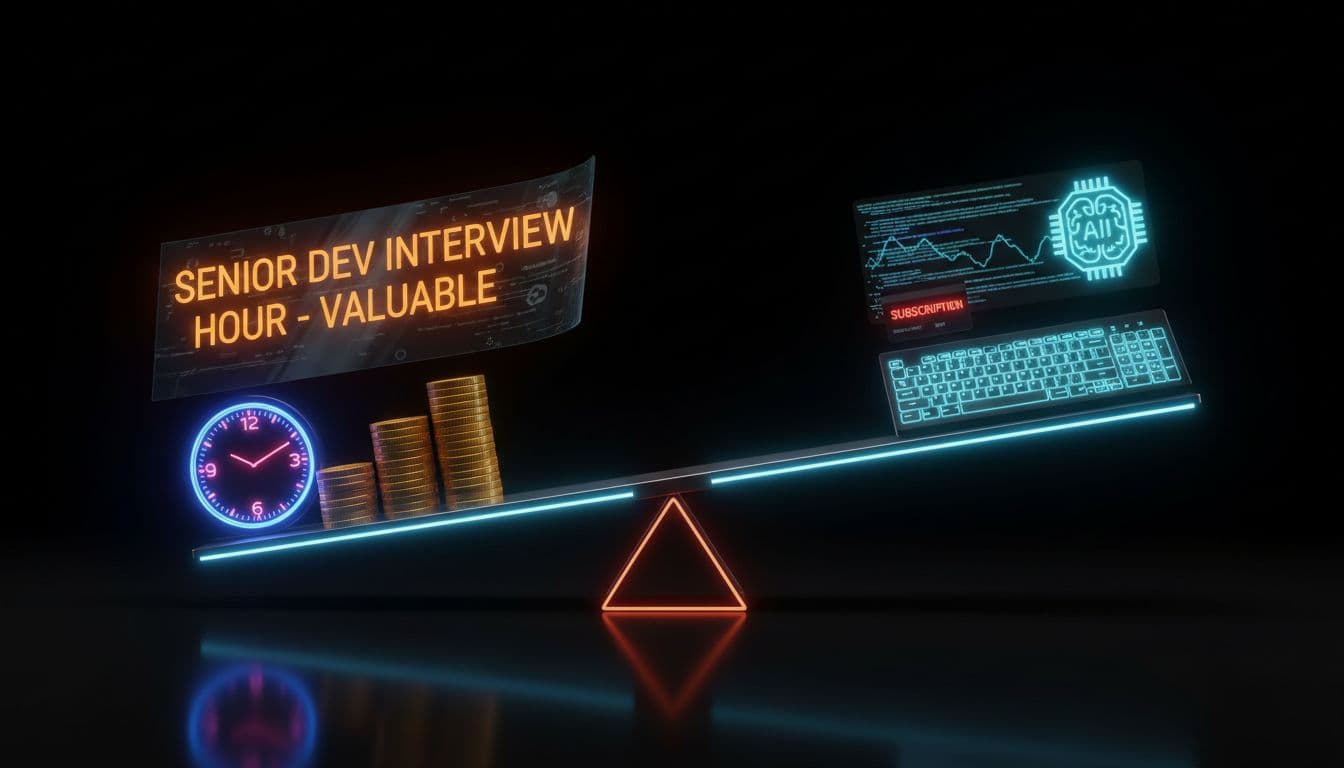
Let’s consider a quantitative lens: Suppose a senior developer’s effective hourly cost is $100. A typical technical hiring round can easily absorb 50+ team hours for interviewing and evaluations. Multiply that across multiple roles per year, and the cumulative cost is staggering—often exceeding the annual cost of an AI recruiter subscription by a wide margin.
The real eye-opener: most teams simply don’t count these hours, leaving a gap in true ROI analysis.
Interview Burnout: The ROI Cannibal Most Dev Teams Ignore
“Interview burnout” isn’t buzzword fatigue—it’s a measurable decline in engagement, focus, and engineering quality driven by repeated hiring cycles. This phenomenon quietly erodes velocity: developers arrive at standups already drained, code reviews slip, and product deadlines start to wobble.
Real-world symptoms include missed releases, a detectable drop in pull request quality, and even rising team churn rates during intense “hiring sprints.” Industry research consistently highlights these productivity dips when core engineers are recruited into the interview gauntlet.
The underappreciated danger: when interview fatigue strikes, it doesn’t just impact hiring—it becomes a drag on product delivery itself. By robbing core contributors of creative and deep work time, interview overload acts as a hidden tax on every release.
See our article on AI Interview Automation for in-depth strategies to reduce fatigue and reclaim engineering capacity.
AI Recruiting: Beyond Cost Savings—Multiplying Return on Engineering Focus
Switching to AI-powered recruiting isn’t just about slashing the obvious costs—it’s about radically multiplying the focus and creative potential of your best developers. Sophisticated AI screening filters out unqualified candidates before a human ever needs to weigh in, fast-tracking only those with the relevant skills and cultural match.
The practical return is immediate: senior engineers are shielded from the applicant noise, reclaiming hours each week for code, architecture, and true innovation. Managers find their hiring pipelines refreshed with shortlists that skip the “maybe” pile, making offer decisions sharper and faster.
Consider this before/after: In one growth-stage startup, switching to an AI-led screening framework reduced human interview hours by 65% in six months, while feature delivery velocity increased by 18%. The impact? More releases, less turnover, and a team that actually looks forward to new hires.
Related: Product Velocity and AI Talent Matching—Unlocking True Engineering Value
Want to see these gains in your team? WorkorAI cuts interview burnout and puts senior dev time back where it matters—on product, not endless filtering.
Calculating Real ROI: A New Blueprint for Engineering Leaders
Ready to count the true cost? Here’s a pragmatic checklist for every engineering manager:
- Audit total interview hours: How many senior/team hours go to interviews each quarter?
- Quantify productivity dips: Look for measurable drops in release cadence, code reviews, or bug metrics during hiring spikes.
- Hidden ramp-up costs: Don’t ignore the slack time before/after interviews as team focus resets.
- AI recruiter calculation: Compare your “lost hours” against a one-year AI recruiter subscription fee.
Worksheet Draft
The recommendation: Move to a “time-first” hiring ROI metric—not just cost per hire, but value per focused dev hour.
FAQ
What is the main hidden cost of technical interviews on engineering teams?
The true cost is the cumulative loss of deep work hours—senior engineers pulled away from core build tasks suffer productivity dips that ripple through delivery pipelines.
How does interview burnout impact core product delivery?
Interview fatigue leads to disengagement, slower releases, and increased risk of mistakes, undermining productivity precisely when it’s needed most.
Is there real data comparing interview hours to AI recruiter subscriptions?
Absolutely. Case studies routinely show that annual AI recruiter costs are far outstripped by the “shadow budget” spent on collective interview hours in a typical hiring season.
How can engineering managers start measuring these costs today?
Start tracking team interview participation, lost sprint points, and recruiting-related cycle time. Use this data to compare against AI-enabled benchmarks.
Will reducing interview volume risk bad hires—or actually improve match quality?
By offloading resume screens and basic filters to AI, teams can focus human effort on final-stage interviews—improving match quality and keeping engineers energized for what matters.
Conclusion
The most forward-looking engineering leaders are reframing interview volume—not as a necessary cost, but as a strategic lever for maximizing team output and morale. When hiring ops are refocused from “time spent” to “value gained,” the ROI speaks for itself: productive engineers, faster releases, and a hiring process built for growth, not attrition. The actionable path? Invest in tools and practices that free your best minds for building—not endless filtering.
Don’t let hidden costs undermine your engineering edge. Try WorkorAI, cut interview burnout, and put your senior team back on the frontlines of innovation. Subscribe, compare metrics, and lead your hiring ROI revolution!
Semantic search finds real react experience now
Discover how Semantic Search and Entity SEO help HR Directors move beyond keywords to find real React experience.
Github analysis or test tasks? code quality wins
GitHub Analysis or test tasks? Tech Leads spot real Code Quality through commit history, not copied challenges.
Hire top 1% developers fast with ai-recruitment
Skip HR headaches—hire top 1% developers via AI-Recruitment and Global Talent, solo-founders choose final fit.