
aihiringrecruitment+2
Workorai’s vision: operating system for talent
Discover WorkorAI’s Vision: an Operating System for global talent, making hiring as easy as deploying code.
Apr 17, 20267 min read
WorkorAI Team
WorkorAI Team
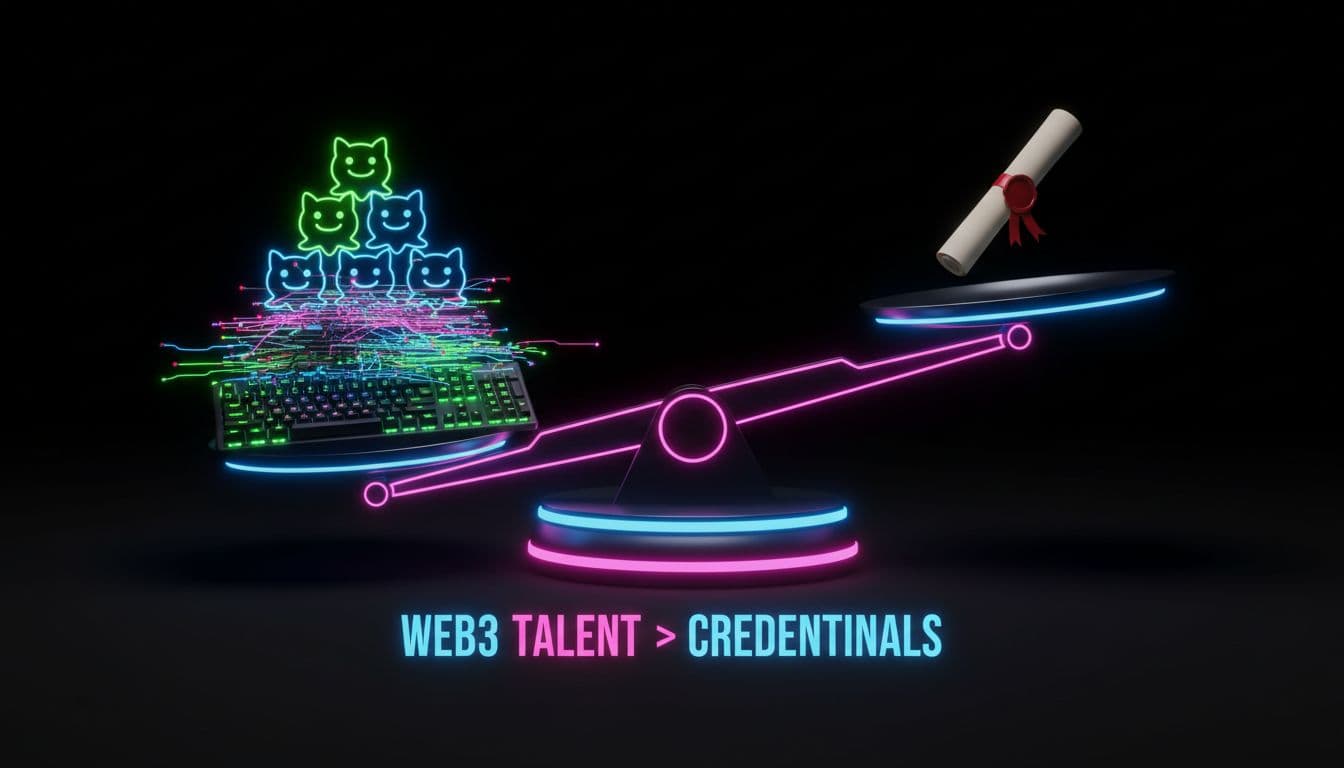
The Web3 talent landscape is changing at breakneck speed—faster than any curriculum committee or alma mater could ever keep pace. As decentralized systems create new rules, traditional degree-centric hiring feels out of sync, almost as if your team is using last decade’s playbook in the middle of a high-stakes, blockchain-powered sprint. For Web3 founders, sticking with credential-based filters isn’t just inefficient—it stifles innovation, agility, and the legitimacy that can only arise from practitioners who’ve already left their mark on-chain. Focusing on real, public proof of skill is the key to building teams that actually win in this turbulent new ecosystem.
The value isn’t hypothetical: founders who prioritize proof over paper tap into a pool of contributors whose abilities are continuously stress-tested under the scrutiny of the Web3 community. The result? Teams that move faster, ship with confidence, and build credibility right into their product DNA.
Degrees and resumes, while well-intentioned in the corporate world, simply cannot capture the kinetic energy and technical depth found in today’s Web3 talent. A diploma proves someone survived a syllabus; it doesn’t say whether they’ve stood shoulder-to-shoulder with open-source giants or survived a DAO governance skirmish.
In contrast, the digital footprints left by Web3 contributors—on-chain transactions, pull requests, and public smart contract deployments—are transparent, verifiable, and permanent. Every commit and audit creates a trail of impact far more revealing than even the most glowing reference letter. This “verifiable impact” is visible to all, erasing ambiguity about who has genuinely contributed and who’s just dusting off their LinkedIn profile.
“Web3 Talent” now means more than a buzzword or a bullet on a CV. These individuals are distinguished by initiative—the kind that can’t be taught in a lecture hall. They join protocol forums, propose upgrades, and actually ship code that governs billions in value. Their community engagement is not a side project; it’s essential to their craft, tightly coupled with a practical understanding of decentralization.
Here are critical skills where degrees simply can’t compete:
Imagine two hiring paths: one candidate offers a bundle of degrees and neatly formatted resumes. The other submits links to smart contracts they've written, battle-tested in top protocols and independently audited—every flaw, refactor, and fix visible to all. Which is the safer bet for a startup worried about attack vectors and time-to-market?
Smart contract audits serve as objective, granular reference checks. No longer does hiring rely on word-of-mouth or scripted interviews: now, founders can see proof of skill in public audit reports and GitHub histories. Industry leaders report that audit-driven hiring not only reduces onboarding time but also slashes post-hire risk. Startups using digital skill proofs consistently see higher code quality and tighter team integration—metrics that simply aren’t visible via diploma-based hiring.
Before: Weeks waiting on background checks and references, uncertain if new hires can deliver amid live fire.
After: Talent can be vetted in a weekend, with contributions and competencies already logged on-chain and in code repositories.
Checklist for Founders
Accelerating the transition to skills-first hiring isn’t just a win for candidates—it’s a strategic growth engine for teams. Tools like WorkorAI streamline this process by automating on-chain and codebase reputation analysis, taking the guesswork out of team formation and reducing the bias inherent in traditional screening. Wondering if your old processes are blocking top hires? This analysis offers a diagnostic checklist.
The implications spill over into onboarding, team diversity, and even DAO governance—where validated skills lead to more inclusive, high-output teams. As Web3 matures, expect emerging proof layers (think: zero-knowledge credentials, decentralized identity, or cross-chain reputation scores) to reshape what it means to “prove yourself” across industries. For a closer look at how automation is ending wage gaps and driving global impact, see this piece. And for the tactical side—passing AI-driven technical screens in a skill-centric world—this guide is essential reading.
FAQ
What is considered solid “on-chain proof” when hiring? Public smart contracts, DAO participation transactions, governance proposals, and audit records all serve as robust, tamper-resistant validation of real-world skills.
How reliable are smart contract audits compared to traditional references? Audits offer objective, code-level scrutiny available for review by any founder—far more transparent and immune to bias than a traditional phone call to a former employer.
Isn’t a university degree still relevant for complex blockchain engineering roles? Degrees may signal foundational knowledge, but Web3 startups consistently find that real, on-chain problem-solving and open-source experience trump academic credentials when speed, trust, and performance matter most.
What mistakes do founders make when switching to skill-based evaluation? Common pitfalls include relying solely on code quality (ignoring security), failing to check actual audit history, or skipping a real-world trial in favor of theoretical tests.
How does WorkorAI improve the Web3 hiring process for startups? WorkorAI enables data-driven evaluation by aggregating candidates’ on-chain, GitHub, and audit footprints—enabling faster, lower-risk, and higher fit matches for scaling teams.
By moving past credentialism and embracing a skills-first, proof-driven hiring methodology, Web3 founders position themselves at the leading edge—not just technologically, but culturally and competitively. Teams built this way move with purpose, reduce risk, and earn the respect of their users and investors through visible, not just claimed, expertise. The future is clear: those who adopt audit, GitHub, and on-chain evaluations aren’t tossing out tradition—they’re upgrading it for an industry where legitimacy starts on the blockchain.
Ready to build a team that sets the pace in decentralized innovation? Test-drive WorkorAI for Web3 skills validation, share your experiences, and help define the new gold standard for decentralized hiring. The next era belongs to those bold enough to prove—and to lead—on-chain. Let’s get started.
Discover WorkorAI’s Vision: an Operating System for global talent, making hiring as easy as deploying code.
Explore the top 10 high-demand skills for remote developers in 2026, with Market Trends and Future Proofing!
Can AI gauge culture fit? See how Soft Skills AI reads interviews to predict Team Dynamics for founders!
More posts
Discover WorkorAI’s Vision: an Operating System for global talent, making hiring as easy as deploying code.

Explore the top 10 high-demand skills for remote developers in 2026, with Market Trends and Future Proofing!

Can AI gauge culture fit? See how Soft Skills AI reads interviews to predict Team Dynamics for founders!